
Advice
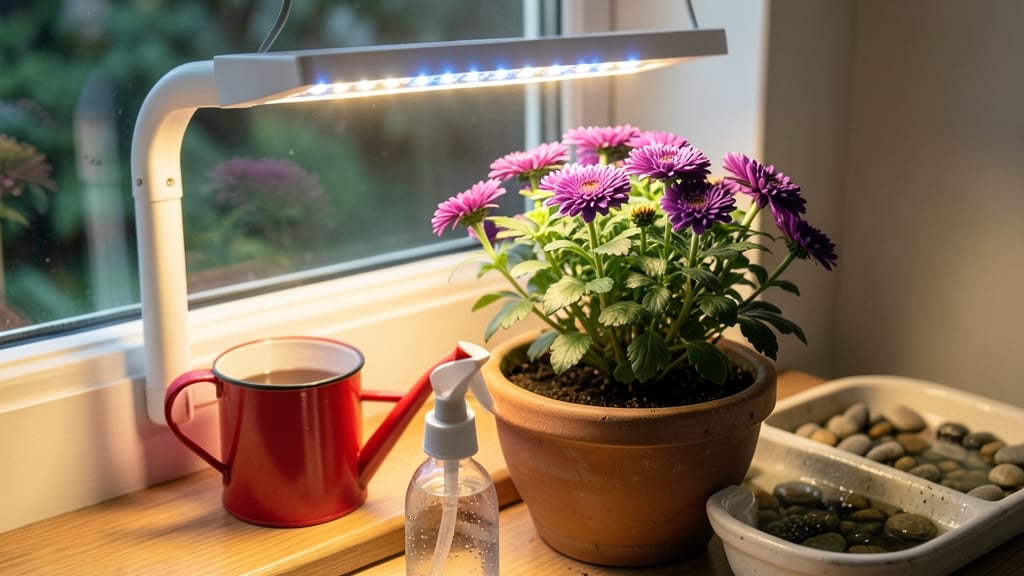
Mums (chrysanthemums) can survive indoors but need bright light and consistent humidity to thrive long-term. Place them near a south-facing window, keep temperatures between 60-70°F, and mist leaves weekly to prevent dryness. Without proper care, they'll grow slowly and produce fewer blooms.
Indoor conditions often create challenges for mums that outdoor environments don't. 🌱 The biggest hurdle is light—most homes lack the 6-8 hours of direct sunlight these plants crave, leading to weak stems and sparse flowering.
I've found that supplementing with a grow light for 12-14 hours daily during winter months makes a dramatic difference in their health. Even with proper lighting, indoor air tends to be drier, which causes leaf edges to crisp and buds to drop prematurely.
What many people overlook is the seasonal adjustment needed for indoor mums. These plants naturally enter dormancy in winter, but indoor conditions can confuse their biological clocks. Reducing watering frequency and providing cooler nighttime temperatures (around 55-60°F) helps simulate their outdoor winter rest period.
I've had the most success with mums that spend their first year outdoors before bringing them inside for winter display.
💡 In This Article
- Why Indoor Light Kills Mum Plant Health
- Indoor Mum Plant Care: Light, Water, and Humidity Hacks
Why indoor light kills mum plant health
Mums rely on photosynthesis to convert light energy into sugars for growth, and indoor lighting typically falls short of their needs. These plants require 6-8 hours of direct sunlight daily to produce enough chlorophyll, but most homes only offer 2-4 hours of indirect light from windows.
Without sufficient light, the plant's metabolic processes slow dramatically, leading to weak stems that struggle to support heavy blooms. The result? Stunted growth and fewer flowers, even with proper watering and nutrients. 🌿
The science behind this involves chlorophyll production—when light levels drop below 1,000 foot-candles (about 10,760 lux), the plant's ability to photosynthesize weakens. South-facing windows provide the brightest natural light (around 2,500-5,000 foot-candles), while north-facing windows offer only 500-1,000 foot-candles.
Grow lights can supplement this deficiency, but they must emit 4,000-6,500 Kelvin light to mimic sunlight effectively, with a focus on blue and red spectrums that drive photosynthesis.
What's often overlooked is how light deprivation affects nutrient absorption. Mums need adequate light to transport water and minerals from roots to leaves—a process called transpiration. Without it, leaves turn yellow (chlorosis) as chlorophyll breaks down, and stems elongate (etiolation) as the plant stretches toward any available light source.
This "leggy" growth makes the plant top-heavy and prone to falling over, especially when blooming. 💡
Indoor lighting also disrupts the plant's natural flowering cycle. Mums typically bloom in response to shorter daylight hours (a process called photoperiodism), but indoor conditions often provide 14-16 hours of artificial light, confusing their biological clock.
This can delay or prevent flowering entirely, even if the plant appears healthy. The key is to replicate outdoor light conditions as closely as possible—using timers for grow lights and positioning plants near the brightest windows available.
For example, a mum placed in a west-facing window might receive 4-6 hours of direct afternoon light, which is better than north-facing but still insufficient for peak health.
Supplementing with a 12-hour grow light session during winter can make up the difference, but the light source must be within 6-12 inches of the plant to be effective.
LED grow lights are ideal because they're energy-efficient and can be tuned to the specific wavelengths mums need for photosynthesis and flowering.