
Plants
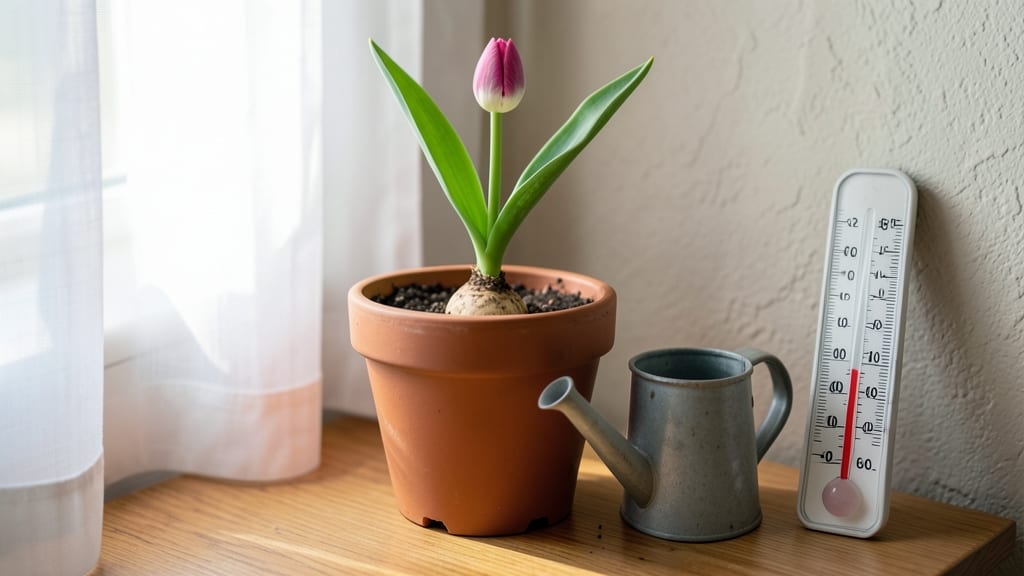
Tulips aren't native indoor plants but can bloom beautifully inside with the right approach: plant them in well-draining containers, expose them to bright indirect light, and simulate outdoor seasons by providing a cold dormancy period to encourage fresh growth each year.
Tulips originate from temperate climates where they experience natural seasonal cycles, including cold winters that trigger bulb dormancy. 🌱 Without this chilling period, indoor-grown tulips often produce weak stems and sparse blooms.
I've found that forcing bulbs in containers—like placing them in the fridge for 10-12 weeks before planting—mimics winter conditions and jumpstarts vibrant spring-like growth indoors.
Even with proper care, indoor tulips typically bloom just once before requiring a rest period. This makes them perfect for seasonal decor rather than year-round greenery. The key to success lies in choosing hardy bulb varieties like Darwin hybrids, which tolerate indoor conditions better than delicate species.
After blooming, let the foliage die back completely before storing bulbs in a cool, dry place until next year's cycle.
💡 In This Article
- Why Tulips Struggle as Permanent Indoor Plants
- Indoor Tulip Care Guide for Seasonal Growth
Why tulips struggle as permanent indoor plants
Tulips evolved in the temperate zones of Central Asia and Southern Europe, where they experience distinct seasonal cycles—including cold winters that trigger their dormancy period. 🌱 Without this 10-12 week chilling requirement (40-50°F), the bulbs fail to properly metabolize stored nutrients, resulting in weak stems and underdeveloped blooms.
Indoor environments typically maintain 65-75°F year-round, which prevents the hormonal shifts needed for healthy regrowth.
The light spectrum indoors also differs significantly from natural sunlight. Tulips need bright indirect light (6-8 hours daily) to photosynthesize effectively, but most homes provide only artificial white light (3,000-4,000K), which lacks the red and blue wavelengths (600-700nm) critical for flowering.
This deficiency causes stems to elongate weakly—a condition called "etiolation"—while blooms remain small or fail to open completely.
Soil conditions indoors often accelerate bulb rot due to poor drainage and inconsistent moisture levels. Tulips require well-aerated, gritty soil mixes (60% potting soil, 30% perlite, 10% sand) to prevent waterlogging, which indoor containers frequently lack.
Overwatering in warm indoor air (humidity 40-50%) creates anaerobic conditions that suffocate roots, while underwatering stresses the bulb's delicate vascular system. 💧
Another critical factor is the lack of natural dormancy cues. In their native habitats, tulips receive environmental signals like shorter daylight hours and cooler temperatures that prepare them for dormancy. Indoors, these signals are absent, causing bulbs to deplete energy reserves without replenishing them.
This energy imbalance often leads to bulb death after just 1-2 blooming cycles—a stark contrast to outdoor-grown tulips that can thrive for decades.
Consider this comparison: Outdoor tulips receive 12-16 hours of sunlight in spring, with temperatures fluctuating between 50-75°F, while indoor setups typically offer only 4-6 hours of artificial light at constant 70-75°F.
This environmental mismatch explains why indoor tulips often produce only 2-3 blooms per stem compared to outdoor varieties that can produce 5-7 blooms on a single stem.
The bulb's natural lifecycle also plays a role. Tulips store energy in their underground corms, which need to fully mature over 6-8 weeks after blooming before entering dormancy.
Indoors, this process is often interrupted by premature removal of foliage (which should remain until yellowing) or inadequate light, preventing the bulb from storing enough energy for next year's growth. 🌿