
Container Gardens
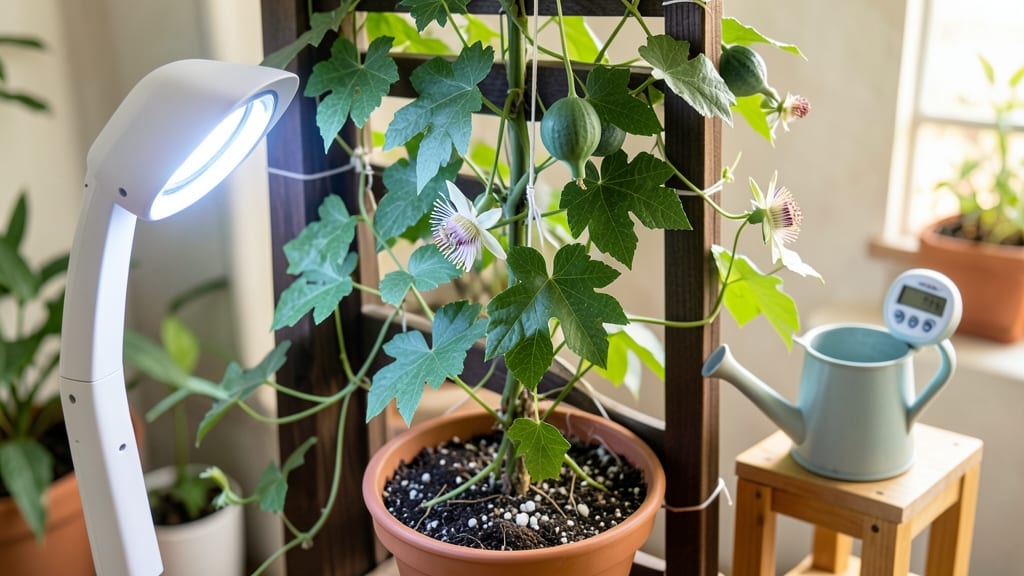
You can grow passion fruit indoors with the right approach, using varieties like Passiflora edulis or Passiflora caerulea that adapt well to container life. Success depends on bright indirect light, a supportive trellis or cage, and consistent humidity—plus manual pollination since indoor conditions often lack natural pollinators. Keep temperatures between 60–80°F for best results.
Indoor passion fruit growing thrives when you mimic tropical conditions without overcomplicating the setup. 🌿 The key is choosing compact varieties like Passiflora caerulea (blue passionflower) or dwarf Passiflora edulis, which produce smaller fruit but adapt better to limited space.
South-facing windows or grow lights (12–14 hours daily) are non-negotiable—these vines crave sunlight intensity. For pollination, use a small paintbrush to transfer pollen between flowers in the morning, when they're freshest.
Don't underestimate the importance of airflow and support. A sturdy 5-foot trellis keeps vines organized while preventing breakage, and humidity trays with pebbles and water (or a daily misting routine) combat dry indoor air.
Prune aggressively in late winter to encourage new growth, but leave some leaves near the base to maintain energy flow. With patience, you'll harvest fruit in 12–18 months—smaller than outdoor varieties, but no less rewarding.
💡 In This Article
- Best Indoor Passion Fruit Varieties and Light Requirements
- Manual Pollination and Indoor Growing Tips for Passion Fruit
Best indoor passion fruit varieties and light requirements
Indoor passion fruit growing starts with selecting the right variety—Passiflora caerulea (blue passionflower) is the most adaptable for containers, producing edible fruit and stunning flowers with minimal fuss. Its vines grow 6–10 feet but can be pruned aggressively to fit 5-gallon containers, making it ideal for apartments.
For tropical fruit lovers, dwarf Passiflora edulis varieties (like 'Panama Red') yield smaller but equally flavorful passion fruits when given consistent care. The key difference? P. caerulea tolerates cooler temps (50°F briefly) while P. edulis demands steady warmth.
Light is non-negotiable—these vines thrive on 6–8 hours of bright indirect sunlight daily, mimicking their native tropical canopy. South-facing windows work in winter, but supplement with full-spectrum LED grow lights (12,000–15,000 lumens) 12–14 hours/day when natural light fades. Place lights 6–12 inches above the plant to prevent leaf burn.
Without adequate light, vines grow leggy and produce fewer flowers—a common pitfall for indoor growers. 🌿 The leaves will tell you everything: deep green with slight red veins means happy; pale yellow means it's begging for more light.
Here's the science: Passion fruit vines use photosynthesis to convert light into energy, but they also need photoperiodism—a 12-hour light cycle triggers flowering. In winter, extend light with timers to maintain this rhythm. For maximum fruit production, rotate containers weekly to ensure even light exposure on all sides.
A 5-foot trellis placed near the window ensures vines grow upward toward light while saving space. Without support, vines sprawl chaotically, leading to weak stems and poor fruit set.
Temperature plays a hidden role in light efficiency. While 60–80°F is ideal, vines in cooler 55–60°F ranges grow slower but absorb light more efficiently—think of it like a plant hibernating to conserve energy. Conversely, temps above 85°F cause leaves to wilt, reducing photosynthesis.
This is why indoor growers in hot climates should use sheer curtains to diffuse direct sunlight while maintaining brightness. The goal? Keep leaves cool enough to photosynthesize but warm enough to stay active.
Pro tip: Monitor leaf temperature with your hand—if it feels warm to the touch (like a human arm), the plant is likely overheating. Adjust light distance or use a small fan (500–1,000 CFM) to improve airflow without creating drafts.
The right balance of light, temperature, and airflow is what transforms a struggling vine into a fruit-bearing powerhouse. 🌟
For those with limited windows, consider reflective surfaces like white walls or aluminum foil behind containers to bounce 20–30% more light onto leaves. This simple hack can mean the difference between a vine that flowers and one that just grows leaves.
And remember: Patience is key—indoor passion fruit vines may take 12–18 months to bear fruit, but the journey is half the reward.