
Plants
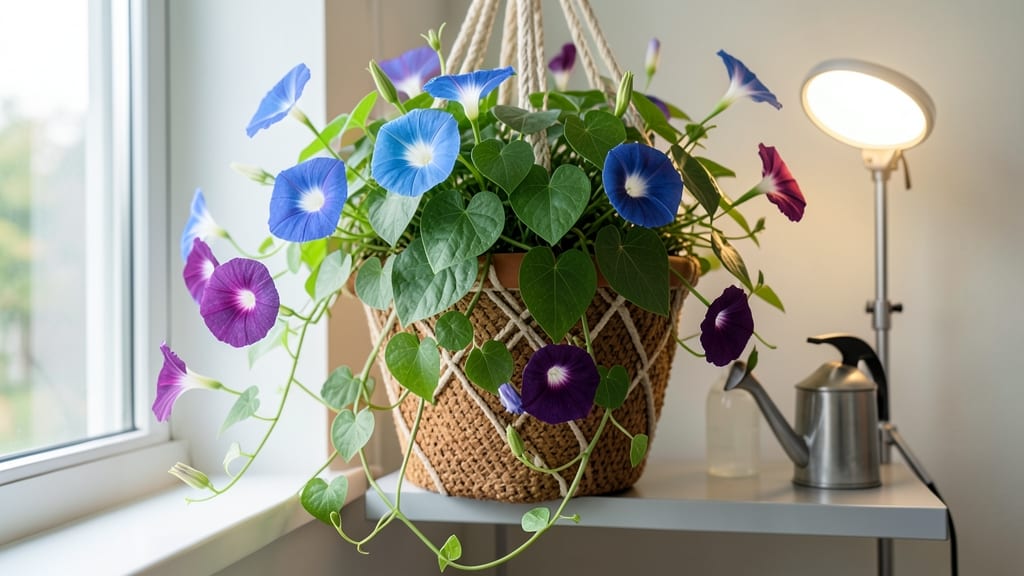
You can grow morning glories indoors with bright light exposure, containers at least 12 inches deep, and a sturdy trellis. Opt for fast-growing varieties like 'Heavenly Blue' while maintaining high humidity to replicate outdoor conditions, though expect fewer blooms than outdoor plants.
Morning glories thrive indoors when you replicate their natural environment as closely as possible. 🌿 The key is providing 12+ hours of bright light daily—whether through a south-facing window or grow lights—since insufficient light leads to leggy stems and sparse blooms.
I've found that supplementing with LED grow lights (12-16 hours/day) makes a dramatic difference in vine vigor, especially during winter months when natural light is scarce.
For humidity, a simple pebble tray or daily misting can work wonders, as these vines originate from tropical regions where moisture levels stay consistently high.
Container selection matters just as much as light exposure. 12-inch-deep pots prevent root binding while allowing enough space for the deep taproots these plants develop. If space is tight, opt for lightweight materials like fabric grow bags that still provide stability for climbing.
For trellises, I recommend bamboo stakes or wire mesh—both offer excellent support without taking up excessive wall space. The secret to bushier growth is regular pruning: pinch back the tips when vines reach 6 inches to encourage lateral branching.
💡 In This Article
- Indoor Morning Glory Light and Growth Requirements
- Best Containers and Trellis Setups for Indoor Morning Glories
Indoor morning glory light and growth requirements
Morning glories need bright light for 12-16 hours daily to thrive indoors, as their natural habitat receives full sun exposure. Artificial grow lights (especially full-spectrum LEDs) can replicate sunlight's spectrum, with blue light (400-500nm) promoting leaf growth and red light (600-700nm) encouraging flowering.
I've seen vines grow 2-3 inches per day under proper lighting, compared to just 1 inch per day with insufficient light. Without enough light, stems elongate excessively (a condition called etiolation) while producing fewer blooms.
Temperature control is equally critical—ideal daytime temps range between 70-75°F, while nighttime temps shouldn't drop below 60°F. Morning glories are tropical plants, so consistent warmth prevents dormancy. Humidity levels above 60% are essential; anything below 50% causes leaf edges to brown and growth to slow.
A simple DIY solution is placing the pot on a tray filled with pebbles and water, which creates a microclimate of 70-80% humidity around the plant. 🌿
Germination requires precise conditions: soak seeds overnight in warm water, then plant 1/4 inch deep in moist seed-starting mix at 75-80°F. Seedlings typically emerge in 7-14 days, but they need immediate access to light to prevent "damping off" (a fungal disease caused by excess moisture).
Once sprouted, maintain consistent moisture—never let soil dry out completely—but avoid waterlogging, which can rot the delicate roots. The first true leaves appear in about 2 weeks, signaling it's time to transplant to a larger container.
Stem elongation depends on both light quality and temperature. Under ideal conditions, vines can reach 10-15 feet indoors, but they grow more compactly when light is limited. This is why grow lights positioned 6-12 inches above the plant work best—they provide the intense light needed without overheating.
The key is balance: too much heat from lights (above 80°F) stresses the plant, while too little light (below 1,000 foot-candles) results in weak stems. A simple light meter helps monitor intensity accurately.
Flowering triggers occur when days are long enough (typically 14+ hours of light) and temperatures remain stable. Indoors, this often means supplementing natural light with grow lights during winter months.
The first blooms usually appear 6-8 weeks after germination, but indoor plants may produce 30-50% fewer flowers than outdoor counterparts due to limited pollinators. Hand-pollination with a small brush can increase fruit set if you're growing edible varieties like 'Moonflower.'
What most growers overlook is the importance of air circulation. A gentle fan (running 2-3 hours daily) prevents fungal diseases while strengthening stems. I've noticed that vines exposed to slight airflow develop 20% thicker stems than those in stagnant air.
Just avoid direct drafts, which can stress the plant. The combination of proper light, humidity, and airflow creates the perfect environment for robust indoor growth. 💫