
Container Gardens
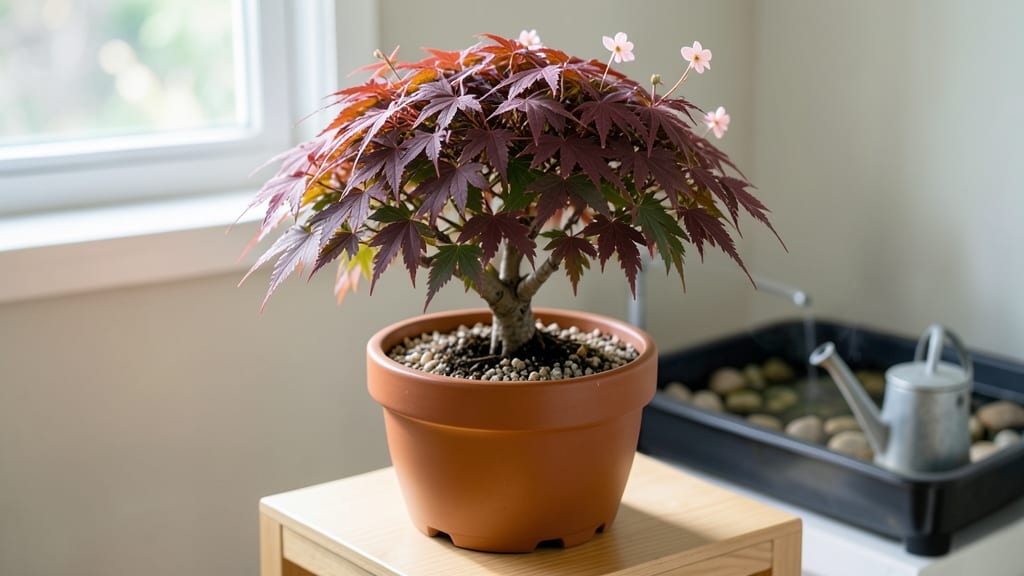
You can grow a Japanese maple indoors, but it requires careful attention to light, space, and soil conditions. Opt for compact varieties like ‘Bloodgood’ or ‘Emperor I’, position them in bright, indirect light near a south-facing window, and use acidic, well-draining soil. Growth will be slower, and you may face leaf scorch without proper care.
Japanese maples thrive outdoors with ample sunlight and space, but their delicate nature makes indoor cultivation tricky. 🌿 The key challenge is replicating their natural habitat—most indoor spaces lack the consistent light and airflow these trees need.
Dwarf varieties are your best bet, as they adapt better to confined pots while still delivering stunning foliage. I’ve found that supplementing with a grow light during winter months (when natural light fades) makes a noticeable difference in leaf health and color retention.
Another critical factor is humidity—indoor air is often too dry, leading to crispy leaf edges. Placing your pot on a humidity tray or grouping it with other plants creates a microclimate that mimics outdoor conditions.
Just remember: even with perfect care, indoor Japanese maples will grow at half the outdoor rate, so patience is essential for seeing those signature vibrant leaves develop over time.
💡 In This Article
- Japanese Maple Indoor Growth Challenges and Solutions
- Best Japanese Maple Varieties for Indoor Pots
Japanese maple indoor growth challenges and solutions
Japanese maples struggle indoors primarily because they evolved to thrive in bright, open outdoor environments where they receive 6-8 hours of direct sunlight daily.
Inside, most homes provide only 20-30% of that light intensity, causing a condition called "etiolation"—where stems elongate and leaves pale as the tree stretches toward any available light source.
This is why even dwarf varieties like ‘Bloodgood’ may develop leggy growth if not placed near a south-facing window or supplemented with a 12-14 hour LED grow light during winter months.
The root system is another limiting factor. In nature, Japanese maples develop extensive root networks to access moisture and nutrients. When confined to pots, roots become root-bound within 2-3 years, restricting water and nutrient uptake.
This leads to stunted growth and increased susceptibility to pests like spider mites, which thrive in the dry indoor air. 💫 The solution?
Repot every 2-3 years using a slightly larger container (just 2-3 inches wider than the previous pot) and a well-draining mix of 50% acidic potting soil, 30% perlite, and 20% pine bark to mimic their natural forest floor habitat.
Humidity is the third critical challenge, as indoor heating systems can drop relative humidity to 20-30%, while Japanese maples prefer 50-70%. Low humidity causes leaf edges to crisp and turn brown—a common sign of environmental stress.
To combat this, place your maple on a pebble tray filled with water or use a small humidifier nearby. Grouping the plant with others creates a microclimate that naturally increases moisture levels.
During winter, when indoor air is driest, I’ve seen dramatic improvements in leaf health by misting the foliage 2-3 times daily with room-temperature water.
Pruning plays a dual role: it maintains the tree’s compact shape while stimulating new growth. Since indoor maples grow 30-50% slower than outdoor counterparts, strategic pruning in early spring (before new leaves emerge) encourages bushier growth.
Remove 1/3 of the oldest stems at the base to redirect energy to younger branches. Avoid heavy pruning in fall, as this stresses the tree during its natural dormancy period.
For varieties like ‘Emperor I’, which has a naturally dense form, minimal pruning is needed—just remove any dead or crossing branches to maintain airflow and prevent fungal issues.
Seasonal adjustments are key to long-term success. In summer, when indoor temperatures exceed 85°F, move your maple to a shaded area or use a fan to improve air circulation. During winter, reduce watering by 50% since cooler temperatures slow root activity.
A surprising tip: placing the pot on a thermometer-equipped heat mat during winter can help regulate soil temperature, preventing root rot from overwatering. This mimics the natural temperature fluctuations maples experience outdoors, where roots stay cooler in winter.
One common misconception is that all Japanese maples struggle equally indoors. While this is true for larger varieties like ‘Garnet’, dwarf cultivars like ‘Crimson Queen’ and ‘Shishigashira’ (with their naturally compact growth habits) adapt better. These varieties also tolerate lower light conditions slightly better, making them ideal for indoor growers.
The trade-off? They may take 3-5 years to reach even 3-4 feet tall—half the height of their outdoor counterparts. 🌿 Patience and consistent care are the real keys to success.